

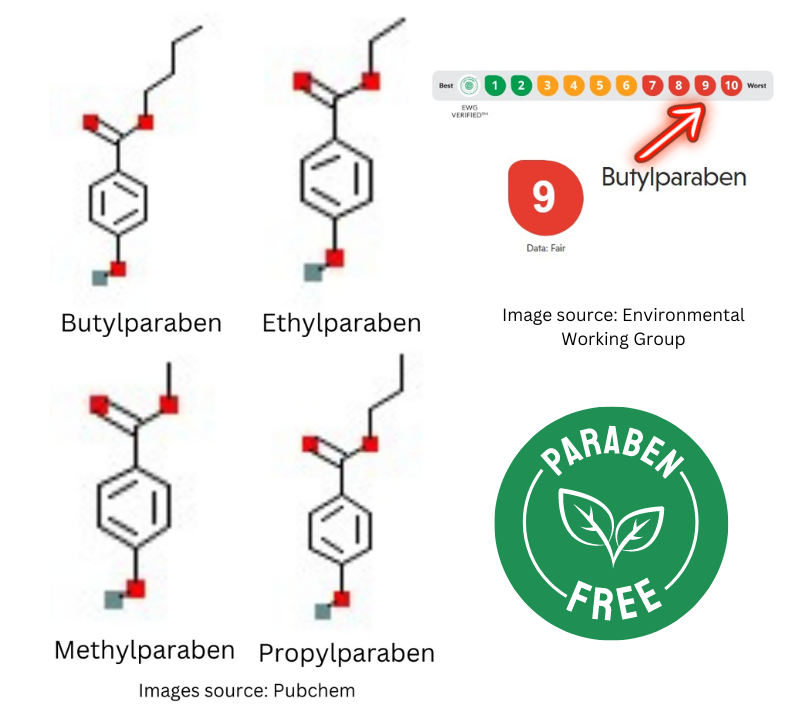
Parabens show up in personal care products as preservatives. They serve the essential safety function of inhibiting microbial growth. They are included as part of a formula to guard against it becoming a factory for bacteria, mold or yeast in case the product becomes contaminated with one of those organisms. There are numerous forms. The most commonly found are butylparaben, ethylparaben, methylparaben and propylparaben. They are similar in structure and properties. Often more than one of them is used to preserve a particular product.
The GOOD: It is hard to match their effectiveness as a preservative. They inhibit most microbial growth.
The BAD: There is evidence that they can cause allergic skin reactions and weakly disrupt hormones. Leave-on formulas are especially risky. A high concentration in a rinse-off formula can also pose a problem. As an example, check out the evidence on butylparaben through the Environmental Working Group or Wikipedia.
Bottom-line: People with sensitive skin conditions (such as rosacea or eczema) or a compromised skin barrier, should avoid parabens in their personal care products. Shopping “paraben-free” labels is helpful, but doesn’t guarantee that the formula doesn’t carry other skin allergens or irritants (nor do words on a label like hypoallergenic, gentle, or sensitive — more on that in another post). See if the brand shares the product’s patch testing result (see the MeridaSKIN Foaming Facial Cleanser as an example).
Good luck,
Shannon Johnson, MSN, NP-C, Founder and Formulator of MeridaSKIN
Shannon L. Johnson NP-C
Founder & Formulator, MeridaSKIN
Shannon is a nationally-certified Family Nurse Practitioner with twenty years of internal medicine experience. She holds Bachelor's degrees from the University of Pennsylvania and Simmons University, a Master's degree from Simmons University, and completed a post-graduate program at the University of Massachusetts Boston. She has worked in primary, emergency and urgent care settings. Ms. Johnson has precepted nurse practitioner students for clinical rotations, mentored new graduate nurse practitioners, and served as adjunct faculty teaching graduate-level pathophysiology and advanced pharmacology. She completed courses in cosmetic formulating to solve her own skin struggle with rosacea, ultimately formulating and founding MeridaSKIN. Shannon enjoys spending time in the beautiful outdoors with her husband and kids.
Recent Comments